canada flag

PROUDLY CANADIAN COMPANY OWNED & OPERATED IN TORONTO SINCE 1989!

CALL NOW

Windows | Doors Blog

How to Choose Chicken Farm Equipment in 2026?

Choosing Chicken Farm Equipment in 2026 requires more than comparing prices and product photographs. Equipment affects flock health, labor demands, energy use, and daily operating consistency. USDA Economic Research Service publications identify feed as a major poultry expense, often near 60% of production costs. That makes accurate feeding equipment especially important. Small errors can become expensive across thousands of birds.

Recent poultry market analyses from Rabobank and the FAO also show continuing pressure on producers to improve efficiency, resilience, and resource use. Automated feeders, nipple drinkers, tunnel ventilation, cooling pads, lighting controls, and manure systems can support these goals. However, technology alone does not guarantee better results. Dr. Michael Czarick, a respected poultry-housing specialist at the University of Georgia, has emphasized, “The best ventilation system in the world will not work if it is not managed properly.” That warning remains practical in 2026.

A good selection process begins inside the house. Check air movement near the bird level. Watch whether feed pans empty evenly. Measure water pressure, temperature, humidity, and electricity use. Compare these observations with manufacturer specifications and independent extension guidance. The right Chicken Farm Equipment must match flock size, house design, local climate, maintenance skills, and expansion plans.

The numbers are not always perfect. Published reports use different farm sizes, regions, and measurement methods. A cheaper system may also demand more labor or repairs. Therefore, this guide examines performance, installation quality, after-sales support, hygiene, energy consumption, and total ownership cost before recommending any equipment.
How to Choose Chicken Farm Equipment in 2026?

Define Farm Scale Using EU Broiler Limits of 30 kg/m² and 750 cm² per Hen

How to Choose Chicken Farm Equipment in 2026?

Farm scale should begin with usable floor area, not building size. For broilers, a practical planning ceiling is 30 kg/m², based on European welfare requirements and farm assurance practices. At a 2 kg market weight, this equals about 15 birds per square metre. A 10,000-bird house therefore needs roughly 667 m² of usable space, before excluding service corridors and fixed equipment.

The European Commission’s broiler welfare framework allows higher densities under strict conditions, but 30 kg/m² remains a more cautious equipment benchmark. It leaves less room for error.

Do not confuse this figure with 750 cm² per hen. Under EU laying-hen rules, 750 cm² refers to space in enriched cage systems, not broiler floor density. That area equals 0.075 m² per hen. EFSA’s 2023 welfare opinion also stresses movement, litter quality, climate, and stocking pressure. Space alone is not welfare. Still, these figures help size feeders, drinker lines, ventilation capacity, litter handling, and backup power.

For a 30 kg/m² broiler plan, select equipment around peak bird weight, not chick placement. Check airflow at the hottest local temperature, then test ammonia near floor level.

FAO production data shows poultry systems are expanding globally, yet climate and labor conditions vary sharply. A standard layout may fail on a humid farm.

I would also leave spare capacity. It costs more now, but overcrowded equipment is harder to correct later. The 750 cm² figure may look precise, but real performance remains imperfect and deserves review after each flock.

Size Feeders and Drinkers for 10–12 Birds per Nipple

How to Choose Chicken Farm Equipment in 2026?

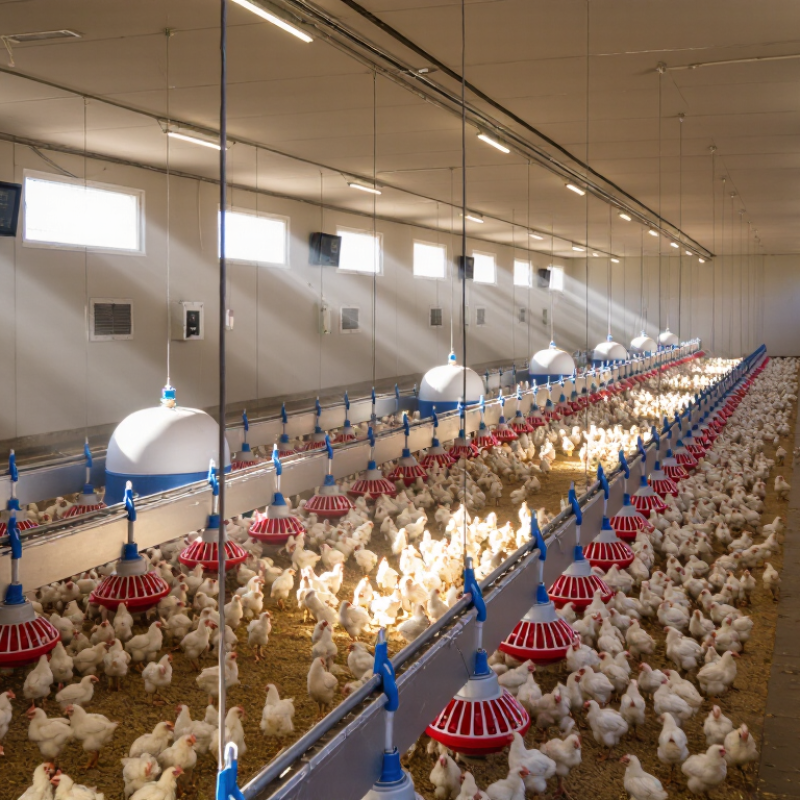
Sizing drinkers for 10–12 birds per nipple is a practical starting point. A house with 1,200 birds therefore needs about 100–120 nipples. I would add a small reserve, because injured or blocked nipples create uneven access. FAO’s Poultry Development Review links reliable water access with feed intake, growth, and flock performance. That connection is easy to underestimate.

Feeder capacity needs equal attention. Provide enough trough space for simultaneous feeding, especially during the first and last daily feeding periods. Many commercial management guides suggest roughly 5–10 centimeters of linear feeder space per growing bird, depending on feeder design and body weight. USDA Economic Research Service cost analyses place feed above 60 percent of typical poultry production costs. Waste from poor adjustment becomes expensive quickly. Keep the lip near the birds’ back height, and check for spilled feed beneath it.

Nipple flow must match age. Young birds need gentle access, while older birds require stronger delivery. A common working range is about 20–40 milliliters per minute, but local water pressure changes results. Measure it with a cup, not by guesswork. I once trusted a layout chart too much. That was a mistake. Walk the house twice daily, inspect wet litter, and record water use. The 10–12-bird rule is useful, but it is not a magic number. Temperature, breed size, and line height still demand adjustment.

How to Choose Chicken Farm Equipment in 2026?

Feeder and drinker planning guide for 10–12 birds per nipple.

Planning assumptions: provide one nipple drinker for every 10–12 birds and at least 10 cm of feeder access per bird. Nipple quantities are rounded up to the next whole unit, while feeder length represents total linear access for the flock.

Select Ventilation to Control Ammonia Below the 20 ppm Welfare Limit

When choosing chicken farm equipment in 2026, treat ventilation as a welfare control system, not merely a cooling tool. Keep ammonia below the 20 ppm welfare limit, including during cold nights. Measure it near feeders, drinker lines, and litter corners. Do not rely on one wall sensor. Use calibrated monitors at bird height, then compare readings across house zones. Fresh air must reach the floor without creating chilling drafts. That balance is easy to miss.

Select variable-speed exhaust fans, adjustable air inlets, and controllers that respond to temperature, humidity, and ammonia readings. Fan capacity should match house volume, stocking density, and local weather exposure. Inlets need enough opening pressure to move air across the ceiling before it descends. Check airflow with smoke or light ribbon tests. Watch the birds, too. Huddling suggests drafts; panting suggests inadequate heat removal. Keep minimum ventilation running in winter. Test it daily.

Equipment cannot repair wet litter alone. Inspect drinker height, leaks, litter depth, and manure accumulation every day. Clean sensors and fans on a written schedule, because dust quietly reduces performance. Record ammonia, humidity, fan speed, and alarm events. Ask a poultry veterinarian or ventilation engineer to review unusual patterns. A common mistake is trusting automatic settings without checking the house. I would leave room for correction. Weather changes, bird age, and litter condition can defeat yesterday’s settings. A useful system depends on measured airflow and timely human judgment.

Prioritize Precision Feeding, Since Feed Represents 60–70% of Costs

Choosing chicken farm equipment in 2026 should begin with the feed bill, not the catalog. Feed often represents 60–70% of operating costs, so small inaccuracies become expensive every day. Select systems that meter portions consistently, match bird age, and reduce spillage around pans. In a practical farm trial, weigh feed delivered and feed remaining for several days. This simple check reveals losses that software may hide. Equipment should also allow quick height adjustments as birds grow. If workers need tools for every adjustment, settings may be ignored during busy shifts. That is a weakness worth admitting.

Tips: Compare equipment by feed conversion results, cleaning time, and calibration stability. Ask for documented test data, service procedures, and replacement-part availability. Check whether sensors remain accurate after dust exposure. Install a small test line before expanding across the house. Observe birds at feeding time: crowded pans, untouched feed, or uneven body weights signal poor distribution. Keep a daily log of feed issued, flock weight, mortality, and leftovers. Numbers do not explain everything, but they expose patterns.

Precision feeding requires more than automatic dispensers. Augers, hoppers, weighing sensors, controllers, and backup power must work together. Choose sealed components where dust and moisture are common, but ensure staff can open them safely for inspection. A reliable alarm should identify an empty hopper or blocked line before birds miss a feeding cycle. Do not accept claimed savings without comparing results across similar flock sizes and seasons. One farm may report excellent performance, while another struggles because feed texture differs. I would also budget for calibration, training, and occasional human error. Perfect operation is unlikely. Better equipment makes mistakes visible sooner.

Verify Automation, Biosecurity, and Energy Performance Before Purchase

How to Choose Chicken Farm Equipment in 2026?

Verify Automation, Biosecurity, and Energy Performance Before Purchase

A practical audit starts with the chicken house, not the sales brochure. Check whether sensors measure temperature, humidity, carbon dioxide, water flow, and feed use continuously. Each alarm should reach a named person within minutes. Automation without reliable alerts is expensive decoration. The OECD-FAO Agricultural Outlook 2024–2033 projects global poultry meat production to grow by about 14% by 2033. That growth increases pressure to manage larger flocks with fewer manual errors. Ask suppliers for uptime records, calibration procedures, and repair response times. Do not accept vague claims.

Biosecurity needs physical details. Inspect the clean-to-dirty route, boot-change area, handwashing point, vehicle access, and washable surfaces. USDA APHIS recorded about 58.8 million birds affected by highly pathogenic avian influenza in the United States during 2022. Equipment cannot prevent every outbreak, but poor layout can spread contamination quickly.

Energy performance also requires measured evidence. Request electricity use in kWh per bird placed, fan efficiency curves, heater consumption, and winter ventilation settings. The European Commission’s BAT guidance for intensive poultry production emphasizes monitoring ventilation, heating, water, and energy use. Compare figures from similar climates. A perfect dashboard may still hide poor maintenance. I would test one house first, review three production cycles, and revise the purchase plan when the data disagrees.

Read Our 5-Star Testimonials

quotes

Amazing service and quality products. Installation was on time and on budget. Our windows look awesome. Edan gave us his full attention from the first call and every step of the way after. Highly recommend.

Adam Rivers Reviewer Image

Adam Rivers

quotes

New windows and door for basement and new metal/glass back door for main house - even through my indecisiveness and the covid-19 challenges Ayal and his installers were patient with me and I am very happy with the look and quality of the install.

homestars logo image
Geraint Reviewer Image

Geraint

quotes

It was a pleasure dealing with Jack and all Delco's stuff. The windows arrived on the date for which were promised. The quality of the service, product and workmanship were excellent. I would gladly recommend Delco to anyone need Windows and Doors

Ruven Y. Reviewer Image

Ruven Y.

quotes

We're so happy with our new front door. Very high quality finish, beautiful window. Installation was impeccable and done very quickly. Hinge and 3-point lock mechanism fit perfectly and feel very solid. Very attentive customer service. Door really ups our curb appeal!

homestars logo image
Jim Bird Reviewer Image

Jim Bird

quotes

I just had my front door replaced and cannot say enough good things about this company. From start to finish their professionalism is outstanding, and the workmanship excellent. Would highly recommend

Maureen Fuller Reviewer Image

Maureen Fuller

quotes

Delco supplies my windows and doors for renovations throughout the GTA. Edan and his staff are the best. Well priced quality products and personalized service. Highly recommended.

homestars logo image
Noah Klar Reviewer Image

Noah Klar

quotes

We have 3 sliding doors and a double front door replaced. All work was done professionally but well qualified craftsman. Watching them work it was clear they new what they were doing and work is first class.

homestars logo image
R. Pierce Reviewer Image

R. Pierce

quotes

We used Delco to replace our windows and patio door and door glass inserts. We are very happy with the quality of the windows and patio door and were very impressed with the installers as well who were very professional and clean. Thank you Nasho and George for your hard work and patience. Also, a big thank you to Ayal who always returned my calls and answered all my questions.

homestars logo image
Sandra Reviewer Image

Sandra

quotes

Delco provided all the exterior doors for our new home build. Ayal was great and the company is very customer service oriented. The doors look beautiful, the hardware is high end and the install went very well. Overall we are very happy with the product and service.

homestars logo image
Sarah Reviewer Image

Sarah

quotes

Ayal and Edan were great to work with. They provided extensive product knowledge and had a great selection in their showroom. The windows and doors changed the whole look of the house and gave a much needed modern yet classic update. Great quality and workmanship! Thank you!

Stephanie Lannaci Reviewer Image

Stephanie Lannaci

quotes

Both my wife and I could not have been happier with the product and service displayed by the owner and the installers. They had kept true to there word and the timelines. The process was catered to our schedule and was seamless.

Fabrizio Macieri Reviewer Image

Fabrizio Macieri

quotes

Had a great experience with Delco. They were professional and did a great job on time.

Joey Oliveira Reviewer Image

Joey Oliveira

quotes

Our experience with Delco Doors has been very good. We needed to replace out front door. Our old 6 feet Steel doors were removed and replaced with Delco 8 feet Fiberglass Doors. The installation went very smoothly, and the guys made sure that everything was fitting squarely and tight. They cleaned up after they were done and were very pleasant to work with. Would highly recommend them.

Angie Gandhi Reviewer Image

Angie Gandhi

quotes

A fantastic company to deal with from start to finish. They were professional, courteous and the project was completed in the timeframe agreed upon. Would highly recommend Delco.

homestars logo image
Linda Reviewer Image

Linda

quotes

I would recommend Delco Windows and Doors without any hesitation. The quality of the products is very good, the installation exceeded my expectations and the responsiveness and punctuality is impressive.

homestars logo image
Serban Dinca Reviewer Image

Serban Dinca

quotes

Very good and timely service. A pleasure to work with Edan Next time I need windows and doors I will definitely call them again

Adrian Nema Reviewer Image

Adrian Nema

quotes

Recently ordered a custom window from Delco. We are extremely happy with the level of customer service - Elyse went out of her way to notify us when the window came in and came in to work on her day off so we could come pick up the window. If we need another window we will definitely come back to Delco!

Jonathon & Sheri Mcintosh Reviewer Image

Jonathon & Sheri Mcintosh

quotes

I would highly recommend this company, the final product was beyond my expectations, My new front door makes my house standout so happy thank you Delco Windows and doors. I will definitely use Delco Windows and doors again in the future thanks to Edan and the installers

Maria Reviewer Image

Maria

quotes

Existing door replacement is a delicate project. I am very satisfied with job well done by Ayal Jack and his installer. Highly professional team, they know their business well, easy to deal with, very accommodating. He guided us step by step to select the best fit for our purpose.

homestars logo image
Alfy Reviewer Image

Alfy

quotes

I would highly recommend this company. They were very easy to deal with, accommodating and professional. The final product was beyond my expectations. The products completely transformed the front of my house and for sure increased its value and curb appeal. Thanks!

homestars logo image
Mi Reviewer Image

Mi

quotes

Happy experience from start to finish. Thank you to Edan for going out of his way to meet us late one evening and his helpful consultation in the showroom especially thank you to the extremely professional, clean and friendly crew of installers. Everything was as promised, the men arrived on time, their work was immaculate and complete, their craftsmanship beyond reproach.

Esther Tobin Reviewer Image

Esther Tobin

We’ll Come To You!

GET A FREE QUOTE

Quality New Windows & Doors. Competitively Priced!

Christine R.

Please, enter a valid value