What Is a Lithium Battery Charger and How Does It Work?
A lithium battery charger does more than refill an empty cell. It controls current and voltage so a compatible battery can charge safely and efficiently. For many lithium-ion batteries, charging uses a constant-current phase followed by a constant-voltage phase. The charger reduces current as the battery approaches its voltage limit. Small details matter: battery chemistry, cell count, temperature, and manufacturer specifications all affect the correct settings.
Isidor Buchmann, founder of Cadex and Battery University, describes the technology this way: “The lithium-ion battery is a low-maintenance system, and most other chemistries cannot compete with it in terms of energy density.” That advantage still depends on appropriate charging. A charger designed for a different battery chemistry may use unsuitable voltage limits. The battery’s protection circuitry can help, but it does not make every charger compatible. Check the label. Match the charger to the battery’s specified voltage and charging profile.
A simple example: a charger may show a green light while a battery sits in a cool garage. That light usually signals a charging status, not a complete health report. It cannot confirm capacity or diagnose every fault. Useful knowledge begins with what the charger controls—and what it cannot. This guide explains the charging process, key components, and practical selection points. Some battery labels are confusing. That deserves a closer look.
What a Lithium Battery Charger Is and What It Does
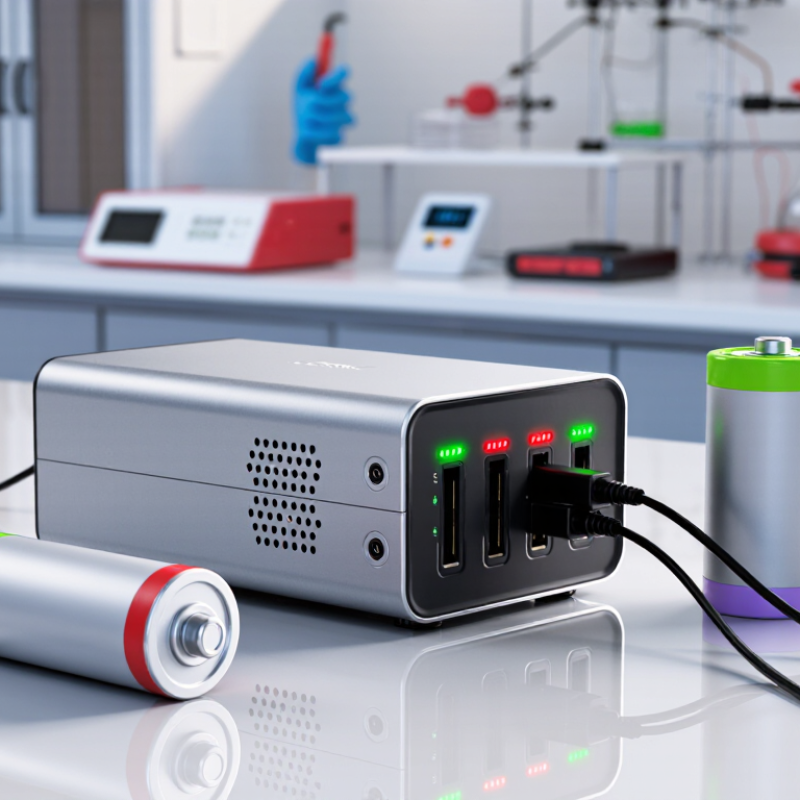
A lithium battery charger is a power-control device designed to charge a specific type of lithium battery. It adjusts electrical current and voltage rather than simply sending power at a constant rate. Many lithium-ion chargers use a constant-current phase, then hold voltage steady as charging current falls. The exact limits depend on the battery chemistry and cell configuration. A charger for one lithium battery is not automatically suitable for another.
The charger’s job is to deliver energy within the battery maker’s specified limits. Some systems also communicate with a battery management system, which can monitor conditions and interrupt charging if needed. That protection is useful, but it does not make mismatched equipment safe. It is easy to assume that matching the plug is enough. It isn’t. Small detail, big consequence.
Tips: Check the battery label or manual for its chemistry, voltage, and recommended charging current. Use a charger explicitly rated for those specifications, and inspect cables for damage. During charging, place the battery on a stable, dry surface and watch for unusual heat, swelling, or odor. Stop charging if anything seems wrong. I may be cautious here, but battery specifications are worth checking twice.
What Is a Lithium Battery Charger and How Does It Work?
A lithium battery charger controls the charging current and voltage to charge a cell safely. This illustrative profile shows a typical single-cell lithium-ion battery using constant-current/constant-voltage (CC-CV) charging: current stays roughly steady while voltage rises, then voltage is held near 4.2 V as current tapers. Actual charging limits and times depend on the cell and its specifications.
The values are illustrative, not a charging specification. Always follow the battery manufacturer’s stated voltage, current, temperature, and cutoff limits.
The Main Components Inside a Lithium Battery Charger
A lithium battery charger is a coordinated set of circuits, not just a power adapter. In a mains-powered model, the input stage filters electrical noise and converts incoming AC into usable DC. Some designs also include power-factor correction. A switching power stage then adjusts that DC to the voltage and current the battery needs. Isolation may separate the output from the mains, depending on the charger’s design.
At the center is the charge controller. It monitors battery voltage and current, then regulates charging according to the battery’s chemistry and cell count. Many lithium-ion chargers use a constant-current, constant-voltage sequence: current is limited early, then voltage is held as current tapers. The exact limits matter. Temperature sensors can pause charging if a pack gets too warm or too cold, though sensor placement may not reveal every hot spot inside a battery.
Protection circuits add another layer. They can stop charging during overvoltage, excess current, or a short circuit, often by controlling electronic switches. A fuse may provide backup protection. That matters. The output connector and cable also affect performance; a loose contact can heat up under load. Not every charger handles these details equally well, so matching its settings to the battery’s specifications is essential. I still think small labels deserve more attention: a clear voltage and chemistry marking can prevent an avoidable mismatch.
How a Charger Regulates Current and Voltage
A lithium battery charger controls how quickly energy enters a battery and how high its voltage rises. It does not simply push power in. For many lithium-ion batteries, charging follows a constant-current, constant-voltage pattern, often called CC-CV. The exact voltage limit depends on the battery’s chemistry and cell arrangement. That detail matters.
During the first stage, the charger supplies a controlled current while battery voltage climbs. A small pack may warm slightly, but unusual heat or swelling is not normal. Once the pack reaches its specified voltage ceiling, the charger holds voltage steady and gradually reduces current. You can picture a tap being turned down as a container nears full. The comparison is imperfect, though: voltage and current must be measured, not guessed.
Charging then ends when current falls to a set level or the charger’s control system determines that charging is complete. A battery management system may monitor individual cells and interrupt charging if limits are exceeded. It is a safety layer, not a substitute for a charger designed for that battery. In practice, displayed charge percentages can be imprecise, and charging behavior may change with temperature, age, or cell imbalance. The charger’s voltage and current settings should match the battery maker’s specifications.
What Is a Lithium Battery Charger and How Does It Work? - How a Charger Regulates Current and Voltage | Charging stage or parameter | What the charger regulates | Typical example or behavior | Purpose and notes |
| Chemistry-specific voltage limit | Sets the maximum charge voltage for the cell chemistry. | Many conventional lithium-ion cells use 4.20 V per cell; LiFePO₄ cells commonly use about 3.65 V per cell. | These are common examples, not universal settings. The cell or battery manufacturer's specifications take precedence. |
| Precharge for a deeply discharged cell | Applies a reduced current while the cell voltage is below its specified recovery threshold. | A typical precharge current may be around 0.1C; the threshold is cell-specific and may be in the approximate 2.5–3.0 V per-cell range for some lithium-ion cells. | C is the cell capacity in ampere-hours. For a 2 Ah cell, 0.1C equals 0.2 A. A cell below its permitted minimum voltage may be unsafe to recharge. |
| Constant-current (CC) stage | Holds charging current near a set value while cell voltage rises. | A charge rate such as 0.5C means a current equal to half the rated capacity per hour; acceptable rates depend on the cell specifications. | The charger monitors voltage and changes to the next stage when the cell reaches its chemistry-specific voltage limit. |
| Constant-voltage (CV) stage | Holds voltage at the specified per-cell maximum while current gradually tapers. | For a compatible 4.20 V lithium-ion cell, the CV target is typically 4.20 V per cell. | The charger must use the correct target for the chemistry and cell configuration; a series battery pack requires suitable pack-level control. |
| Charge termination | Stops or ends the charge cycle when current tapers to the configured termination level. | A common termination range is approximately 0.05C–0.1C, subject to the cell and charger specifications. | Many lithium-ion charging systems do not use continuous trickle charging after a full charge; the system may disconnect or restart when voltage falls. |
| Temperature and fault monitoring | Checks temperature and electrical conditions, and reduces or interrupts charging when limits are exceeded. | Permitted charging temperatures vary by cell; many cells prohibit charging below 0°C, but the datasheet defines the actual range. | A battery management system (BMS), where present, can provide additional protection against overvoltage, overcurrent, and temperature faults. |
Note: Lithium battery charging parameters are chemistry- and model-specific. Use a charger designed for the exact battery, and follow the battery manufacturer's charging limits.
How Battery Monitoring Supports Safe Charging
A lithium battery charger regulates current and voltage to match a battery’s specifications. Battery monitoring adds another layer of protection. It tracks conditions during charging, rather than relying on the charger’s settings alone.
Inside a multi-cell pack, a battery management system can monitor individual cell voltages. Small differences matter. If one cell nears its upper voltage limit, the system may reduce or interrupt charging. It can also balance cells, helping prevent one cell from reaching its limit before the others. A green indicator is useful, but it does not tell the whole story.
Temperature matters, too. Sensors can detect heat near the cells and trigger a warning or stop charging when readings move outside the permitted range. This is especially relevant in a warm room or when a battery feels unusually hot. Not every charger monitors each cell or temperature directly, so check the equipment specifications. Monitoring is not a substitute for using a compatible charger or inspecting damaged cables. It can be tempting to trust an automatic cutoff completely. A careful look at unusual warnings still matters.
Charger Types and Battery Compatibility
A lithium battery charger controls current and voltage; it is not simply a power adapter. Most use a constant-current, constant-voltage profile. Current rises steadily, then voltage is held while current tapers. This matters because lithium-ion cells and lithium iron phosphate cells have different voltage limits. A common lithium-ion cell reaches about 4.2 volts; many lithium iron phosphate cells reach about 3.65 volts. These are typical values, not universal settings. Check the battery label or manufacturer’s technical sheet.
Charger types include single-chemistry models, configurable chargers, and device-integrated charging circuits. A configurable unit may support several chemistries, but only when the correct profile is selected. Match cell count, chemistry, and charging voltage—not just the plug shape. A four-cell pack, for example, needs a different voltage than a single cell. Some packs also require a compatible battery-management system for protection and cell balancing. That detail is easy to miss.
The scale of battery use makes compatibility more than a workshop concern. The International Energy Agency reported that electric-car battery demand exceeded 750 GWh in 2023, reflecting the growing range of battery systems in circulation. That figure does not mean chargers are interchangeable. They are not. When specifications are unclear, avoid guessing from appearance; even a charger that fits can apply the wrong profile. Check the pack’s stated chemistry and maximum charge voltage before connecting it.